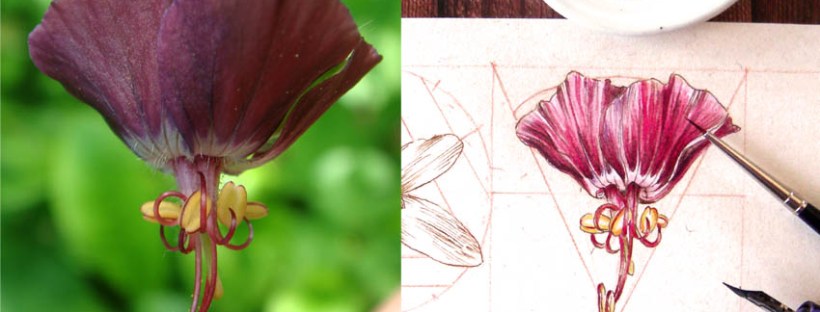
This is one of my favourite flowers and this is due in part to the beautiful botanical illustration of Arthur Harry Church representing a cross-section of the flower and showing the grace of its curved filaments. So often an exceptional botanical illustration made me pay more attention to a botanical subject, which I would otherwise … Continue reading Daily Sketches – June 30 Flowers – 5. Geranium phaeum
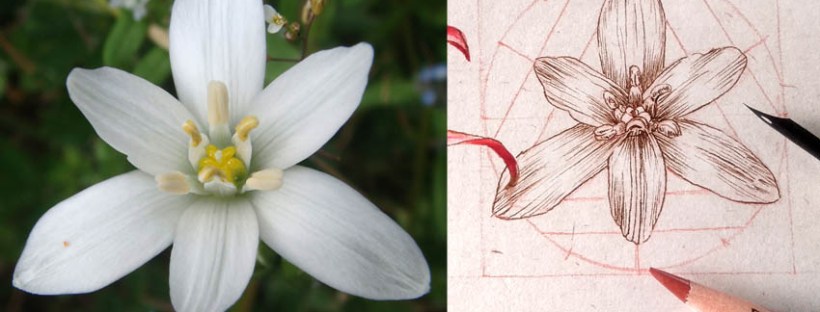
Daily Sketches – June 30 Flowers – 4. Ornithogalum umbellatum
Ornithogalum umbellatum or star-of-Bethlehem is a bulbous plant that can be found in Romanian meadows from mid to late spring and it is related with many familiar garden plants such as hyacinth, bluebells, grape hyacinths and squills. The petal-like perianth is radially symmetric and consists of six lanceolate tepals, 3 smaller than the other 3, … Continue reading Daily Sketches – June 30 Flowers – 4. Ornithogalum umbellatum
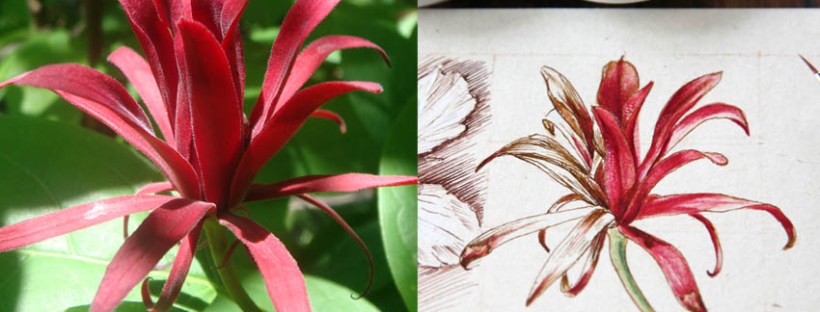
Daily Sketches – June 30 Flowers – 3. Calycanthus floridus
Shrub native to North America, Calycanthus floridus was brought to Europe for its decorative value, being appreciated for the brown-cherry flowers and for its fragrance with fruity notes of pineapple-strawberry-banana. As the flowers mature they start to smell like ripe apples or vinegar. Not only the flowers, but also the leaves and bark have a … Continue reading Daily Sketches – June 30 Flowers – 3. Calycanthus floridus
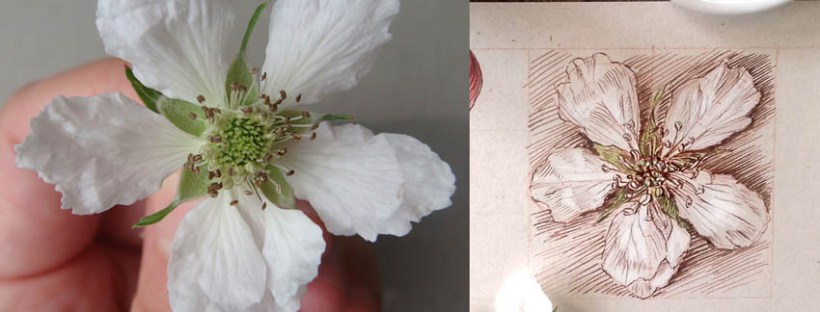
Daily Sketches – June 30 Flowers – 2. Rubus fruticosus
The blackberry (Rubus fruticosus) is now in bloom in the garden and its flowers are in a beauty contest with the Philadelphus flowers next to it. The name of the species does not, as some might imagine, mean fruit-bearing; in that case the name should be fructuosus. Fruticosus in latin refers to the bushy, shrubby … Continue reading Daily Sketches – June 30 Flowers – 2. Rubus fruticosus
Daily Sketches – June 30 Flowers – 1. Fuchsia
Starting today, I will upload a video daily on my Patreon, within a project spread throughout June in which I will draw a botanical topic per day. June is dedicated to flowers. I will draw with ink and watercolor on a A3 paper, grid of 5x5cm squares, with an empty space on the right for … Continue reading Daily Sketches – June 30 Flowers – 1. Fuchsia
Sketching a Blue Anemone with Ink and Watercolor
Have you noticed how many anemone species are booming in the spring? I was surprised to see in our area no less than 5 species of anemone: 1. A. ranunculoides (yellow anemone, yellow wood anemone, or buttercup anemone)2. A. sylvestris syn. Anemonoides sylvestris (snowdrop anemone)3. A. blanda (the balkan anemone)4. A. nemorosa ( wood anemone) … Continue reading Sketching a Blue Anemone with Ink and Watercolor
How to Draw Flowers like Leonardo da Vinci
Even though they are impressive, the botanical drawings of Leonardo da Vinci are not highly publicized. Partly because there are only few of them and partly because, in the spirit of that time, they were conceived as preliminary sketches for paintings, and not as drawings in themselves or as in-depth botanical studies. In fact, not … Continue reading How to Draw Flowers like Leonardo da Vinci
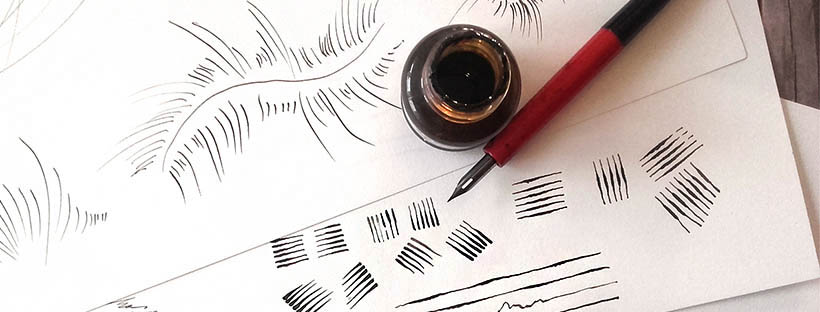
Drawing with Dip Pen and Ink. Marks
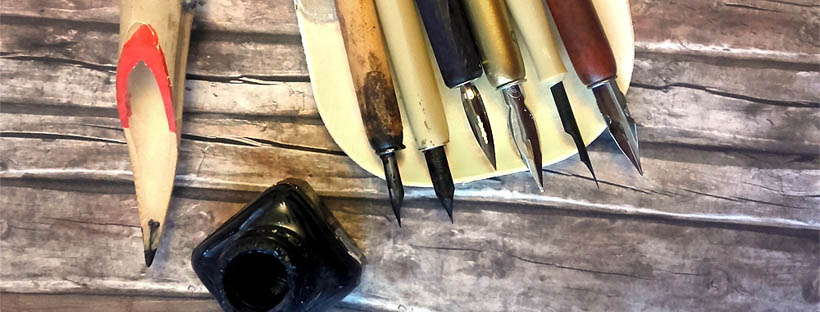
Many artists today, including me, draw with liners. They are smudge proof, waterproof and allegedly lightfast. They provide you with a constant flow of ink, they are not messy and easy to transport. Drawing with liners looks more like etching. It can be brought to the level of fine art and it is something I'm … Continue reading Drawing with Dip Pen and Ink. Marks
Drawing with Dip Pen and Ink. Materials
While with watercolor I came to the conclusion that I am not interested in photorealistic rendering and I'm happy with more loose, suggestive recordings, for which any paper, brush or watercolour will do, with ink I'm still searching for the best ink, nib and paper. By "best" I mean the perfect equilibrium between the quality … Continue reading Drawing with Dip Pen and Ink. Materials
Between Art and Science
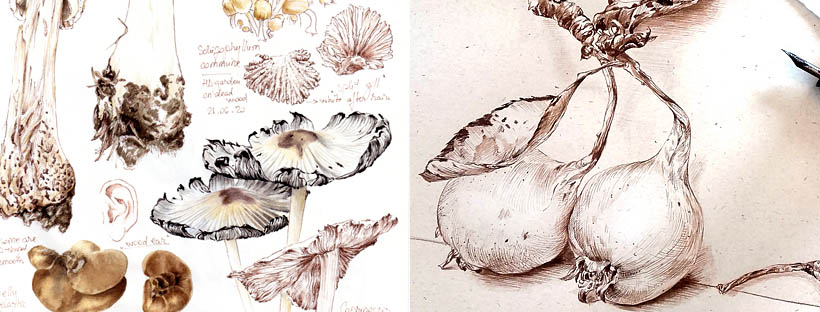
These days my creative work is divided between Botanical Portraits and the Botanical Journal.Drawing portraits of plants is mostly about beauty and art. Using old masters techniques and translating them into what I think I can call already my own handwriting, I try to capture the essence, the graceful movement, the perfection I see in … Continue reading Between Art and Science